
Socialization and training start at home in the first days, and for puppies a well-run class picks up where your living room leaves off. Your puppy is already inside the window that shapes how they handle the world, and your kitten is at the very end of theirs, while the vaccine series still has weeks to run. In that stretch, new people, surfaces, sounds, and handling get filed away as ordinary or as something to fear, and that filing is where a lot of adult anxiety and behavior problems begin. You do not have to trade safety for it: a good class and steady at-home work fill those weeks with useful experiences while keeping your pet off the public ground where parvovirus can survive in soil for up to a year.
Valley Center Veterinary Clinic is an AAHA-accredited hospital, and your puppy or kitten's first few months are the ones we most want to be part of. Our puppy wellness plans and kitten care packages are built around that period, with exams and technician appointments spaced across the year, so you always have somewhere to take the questions that come up between vaccines. We can tell you when a class is safe to start, what a good one looks like, and which experiences to build at home before then, along with the reasoning behind each answer, because you are the one doing most of this work. If a new puppy or kitten has just joined your family, set up their first visit and we will plan those early weeks together.
What Builds a Calm, Confident Adult Pet
- The weeks when a young brain decides what's normal are mostly over by fourteen weeks in puppies and earlier in kittens, which is why early experience outweighs later training.
- Safe socialization means short, positive introductions on ground you control, not a trip to the dog park before the vaccine series is finished.
- Reward-based training and predictable routines lower anxiety, while corrections and punishment raise the odds of fear and aggression later on.
- A sudden change in behavior at any age deserves a medical exam before it gets a training plan, because pain and illness often look like a behavior problem.
Why Does the Socialization Window Close So Early?
The socialization window opens around three weeks of age and starts closing by about fourteen weeks in puppies, and as early as seven to nine weeks in kittens, so the most formative weeks of your pet's emotional life happen before the vaccine series is finished.
A young brain treats novelty as information, not as a threat. A kitten who meets three relaxed strangers at nine weeks files people under "fine." The same kitten meeting a first visitor at six months has nowhere to file that person, and caution becomes the default.
Reading your pet matters more than finishing a checklist.
| What to watch | Comfortable and curious | Worried and near their limit |
| Body | Loose and wiggly, leaning toward the new thing | Crouched low, weight back, tail tucked or clamped |
| Face | Soft eyes, open mouth, ears forward | Ears flattened or swiveling, hard stare or eyes squeezed shut, whiskers tight |
| Movement | Chooses to approach, shakes it off, comes back for more | Freezing, creeping, hiding behind your legs, trying to leave |
| Appetite | Takes treats neatly and asks for more | Won't eat, or grabs with a hard mouth |
| Recovery | Startles, then back to sniffing within seconds | Stays tense for minutes after the thing is gone |
What Does Good Socialization Actually Look Like?
Good socialization is quality, not mileage. It's a brief, controlled meeting your pet chooses to walk into, with something delicious happening while they're there, that ends while they're still relaxed. Twenty easy experiences beat one overwhelming afternoon at a crowded farmers market.
Flooding a young animal with more than they can handle teaches the opposite lesson. Many of the common behavior issues that surface in adolescence, such as barking at visitors, lunging on leash, or bolting under the bed at the doorbell, trace back to a young animal who never got a calm introduction to any of it.
The targets are the same categories for both species, though the settings differ.
| What to introduce | For puppies | For kittens |
| People | Men with beards and hats, kids at kid volume, a cane or a wheelchair | Visitors who sit down, toss a treat, and otherwise ignore the kitten |
| Surfaces | Grass, gravel, metal grates, wobbly cushions, a flight of stairs | Tile, carpet, a towel on a counter, the inside of a sink |
| Sounds | Doorbell, vacuum, traffic, storm recordings played low | Kitchen clatter, hair dryer, the carrier door |
| Handling | Paws held, ears checked, lip lifted, a nail tip trimmed, brief restraint | Toes pressed to extend a claw, ears touched, being lifted and set down |
| Other animals | Known, healthy, vaccinated dogs of a similar size and play style | A resident cat met through a cracked door or baby gate first |
Kittens do nearly all of this at home, since most towns have no kitten equivalent of puppy class. Both species benefit from a social visit, and we are glad to have a puppy or kitten come in just to meet the people who will be handling them and take a treat on the scale.
How Do You Socialize Safely Before the Vaccine Series Is Finished?
The ground is the risk, not the outing. Until the series is done, early experience happens in places you control: your living room, a friend's clean kitchen with a healthy vaccinated dog, your own arms on a bench outside the hardware store, and a class that checks vaccine records at the door.
Should Puppies Start Class Before Their Last Round of Shots?
Puppy classes can start as early as seven to eight weeks, once a puppy has had one set of vaccines at least seven days beforehand and a first deworming, because behavior problems take far more young dogs' lives than infectious disease does. A good class runs small, groups play by size and style, floors are non-porous and cleaned between sessions, and the instructor rewards what they want instead of correcting what they don't.
Where you don't go matters just as much. Parvovirus lingers in dirt long after the dog who shed it has moved on, so the grass strip outside the pet store, the freeway rest stop, and the dog park all wait. Your puppy's vaccine schedule tells us which week class becomes a reasonable risk, so bring it up at your next appointment.
How Do You Teach a Cat to Like the Carrier and a Puppy to Like the Leash?
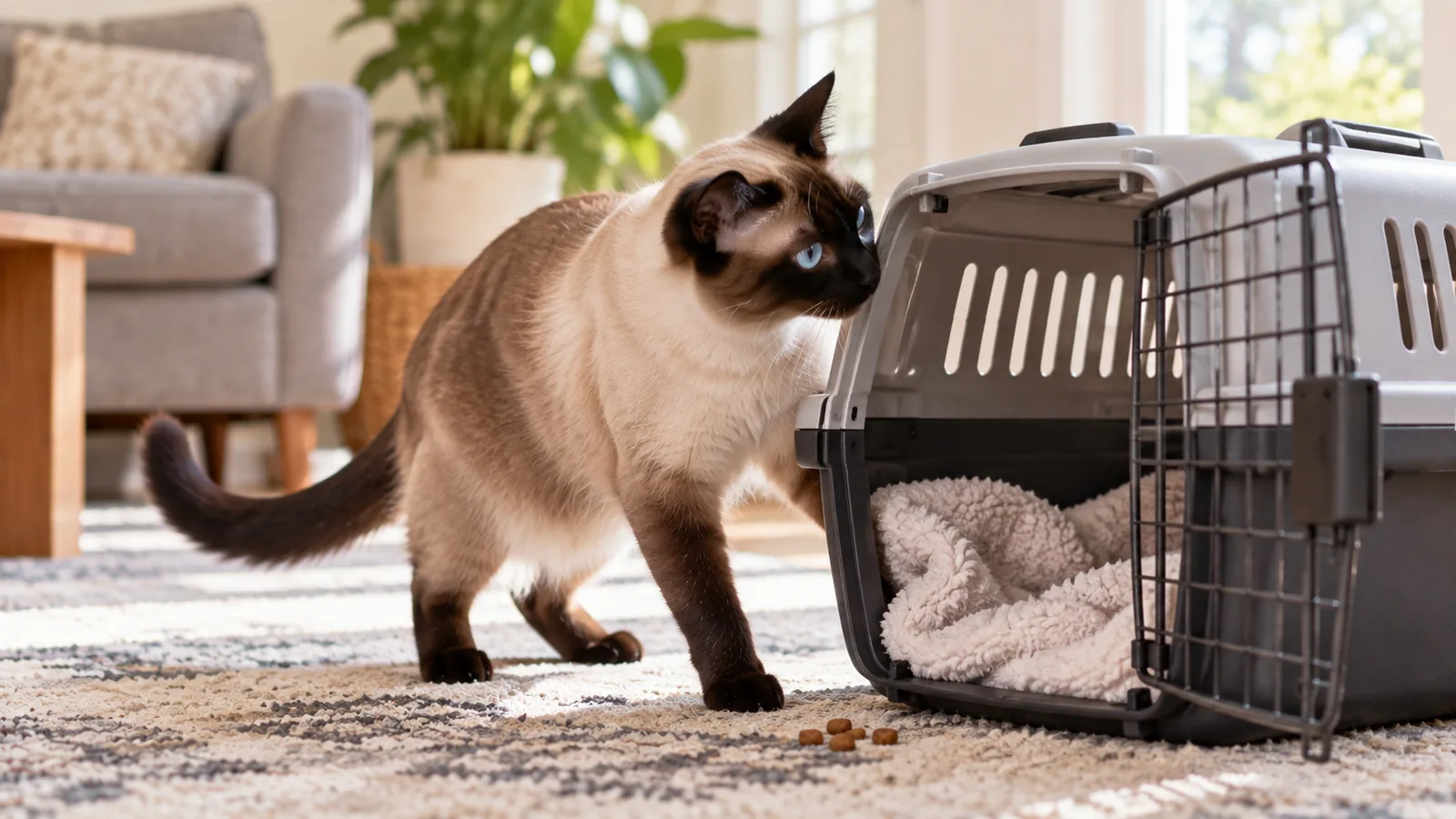
Carrier training works when the carrier lives in the living room all year with a soft bed and the occasional treat tossed inside. It stops being the object that appears right before something unpleasant. Feed a meal or two in there, and take the door off for a month if that helps.
Leash work starts the same way, by paying for what you want rather than fixing what you don't. Clip the leash on indoors and drop a treat next to your left shoe whenever your puppy drifts into that spot, long before there's a squirrel involved. Kittens can learn a harness too, with the same slow build. Wheels deserve their own sessions. A dog who meets their first bicycle at eight months often decides it's prey or a threat. Let skateboards, bikes, strollers, and scooters roll past at a distance your pet can handle while cheese arrives each time.
Does the Way You Train Change How Anxious Your Pet Becomes?
How you train matters as much as what you teach. Methods built on fear or pain can stop a behavior in the moment, but they also teach a young animal that bad things arrive without warning and come from the person they live with.
Why Reward-Based Training Builds a Calmer Pet
Positive training teaches a pet what to do rather than punishing what they already did. Prong collars, shock collars, leash pops, and alpha rolls can suppress a growl or a jump, but suppression isn't comfort, and the research links those tools with higher rates of fear and aggression down the road. Cats are on the same list, even though nobody calls it training: spray bottles, scruffing, and shouting teach a cat that you're occasionally dangerous, a rough foundation for nail trims at three years old.
How Much Does Routine Matter, Especially for Cats?
Predictable days matter more than most households realize. Meals at roughly the same times, litter boxes that stay put, and a resting spot nobody disturbs give a cat a baseline to relax against, and dogs benefit too. When a move or houseguests break the routine, keep feeding times and box locations unchanged.
How Do You Make Vet Visits and Grooming Easier?
Preparing for vet visits starts weeks ahead on your own living room floor, in ten-second sessions of touching paws, lifting a lip, and looking in an ear, each one followed by something delicious. By the time we do the same things in our Valley Center exam room, it's a familiar game played by a new set of hands.
Cooperative care goes a step further by letting your pet say yes. A dog taught to rest their chin in your palm can end the session by lifting their head, and cats learn a version of it standing on a towel for brushing. A puppy who accepts a finger brush at twelve weeks is also a far easier patient for the dental care we'll provide years later.
Lip licking, yawning when nobody is tired, a head turned away, and the whites of the eyes showing are stress signals that show up long before a growl does, and punishing the growl only deletes the warning while leaving the fear in place. A cat who flattens their ears and goes completely still is out of options, not cooperative. Stop while the session is still easy and pick it up tomorrow.
Which Anxiety Behaviors Can You Head Off Right Now?
The patterns we treat most often in adult pets all have small, early versions that get practiced into habits. Caught at four months, most of this is prevention. Caught at four years, it's treatment.
- Leash reactivity: Reactive behavior on leash, the barking and lunging that reads as aggression from across the street, is almost always fear, and it improves with distance and a reward for looking away rather than a firmer correction. When your puppy notices another dog, mark the moment they glance back at you and pay for calm with a great treat.
- Resource guarding: The trade game, where you hand over something better in exchange for whatever your puppy grabbed, teaches that an approaching hand adds something good, not the old advice to pull the food bowl away mid-meal. Practice with low-value items first, and drop something wonderful in the bowl as you walk past.
- Separation anxiety: Dogs with separation anxiety pace, howl, scratch door frames, and have accidents despite being house-trained, usually within the first fifteen minutes after the door closes. Prevention is built from short absences on purpose, a stuffed chew while you're in the next room, and departures that stay boring.
- Noise fear: Recordings of thunder or fireworks played at a volume your pet barely registers, paired with dinner and nudged louder over weeks, are standard desensitization, and comforting a frightened pet doesn't reinforce the fear. For the ones who truly panic, medications made for noise events work well, and the time to ask us is before the Fourth of July, not during it.
- Tension between housemates: Most tension among cats sharing a home is competition over resources, and separated feeding stations, one more litter box than you have cats, and vertical escape routes fix more than any correction will. Between dogs, supervise time with high-value toys or chews, separate at meal times, and make sure each dog gets quality time with their human without the other dog butting in.
Can Enrichment Really Lower Anxiety?
A pet with nothing to do doesn't relax. They invent a job, and the built-in needs to sniff, chew, shred, stalk, and chase come out as window barking, chewed baseboards, or a cat sprinting laps at three in the morning when nothing else meets them.
Dog enrichment doesn't require a shopping trip, since a muffin tin with treats hidden under tennis balls or a box stuffed with crumpled paper gives a dog the sniffing and problem-solving work that otherwise goes into your couch cushions. Scatter breakfast in the yard instead of using a bowl, and let walks include five minutes of sniffing whatever your dog wants.
Cats need the hunt, not just the meal. Two short wand-toy sessions a day that end with a catch and then food follow the natural sequence, and food puzzles, paper bags, and a window perch cover the rest cheaply. Calming supplements and pheromone diffusers take the edge off for some pets while the training work happens, so ask us if you should add one, and never give human anti-anxiety medication or a housemate's leftover prescription, since the drugs and doses that suit people can be dangerous for pets.
When Should a Behavior Change Send You to Us?
Any sudden shift in behavior needs a medical exam before it gets a training plan. A house-trained cat who starts missing the box, a friendly dog who snaps when a hand comes near their hip, a pet who stops taking the stairs: these are pain, a hormonal change, failing vision or hearing, or something neurologic until proven otherwise. A puppy or kitten who freezes, hides for days, or growls over food at ten weeks isn't going through a phase, and that's worth an appointment now rather than a wait-and-see until the next vaccine visit.
A hands-on exam plus in-house bloodwork and imaging answers most of these questions, and thyroid values, urine testing, and an orthopedic exam fill in the rest. If the behavior needs more than we can build in an exam room, we refer to a veterinary behaviorist and help you get that appointment.
What New Puppy and Kitten Families Ask Us
Is It Too Late If My Puppy Is Already Five Months Old?
The window has narrowed, not slammed shut. Adolescence is still a period of real change, and plenty of six-month-old dogs learn that strangers and skateboards are fine. The difference is pace: you'll work at greater distances, use better food, and give each new thing more repetitions than an eight-week-old would need.
My Kitten Hides From Everyone. Should I Pull Them Out to Meet People?
Pulling a hiding kitten into a room full of people usually confirms their worst theory about people. Leave the hiding spot available, have visitors sit on the floor, talk quietly, and ignore the kitten while tossing treats in that direction. Most kittens come out on their own within a visit or two once nothing bad happens.
What If My Puppy Gets Sick or Hurt in the Middle of All This?
A sick or injured puppy should be seen the same day, so bring them in. We handle urgent and emergency care during our open hours, and walk-ins for emergencies are always welcome when staffing allows, with critical cases transferred to a nearby emergency hospital if that's what a patient needs. We'll go over what we're seeing, what we recommend, and the upfront pricing before anything gets started.
Starting Early Pays Off for the Next Fifteen Years
Everything you build in these few months buys something later: a dog who stands politely for a nail trim, a cat who walks into the carrier, a pet who handles a thunderstorm without falling apart. Most of what's hard to fix in an adult pet was straightforward to prevent in a puppy or kitten. No question is too small at Valley Center Veterinary Clinic, whether it's about which class to pick, a carrier your cat hates, or something your nine-week-old did last night. When you're ready, schedule a wellness visit and we'll map out the next few months with you.