

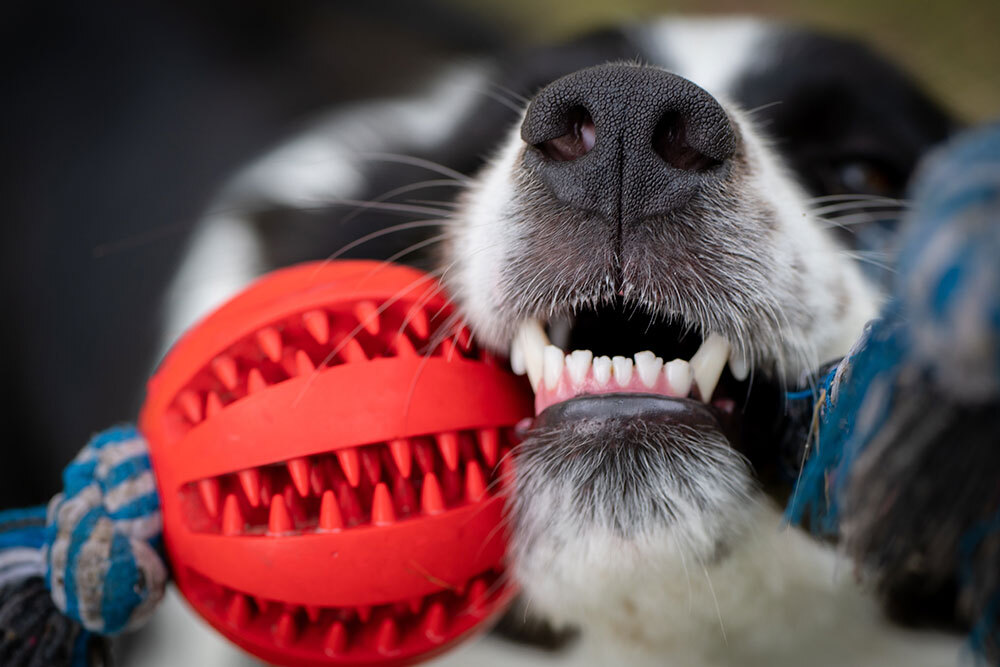
Many of the toys, chews, and collars sold at the pet store are not as safe as the packaging suggests, and the ones that cause the most damage tend to be the ones people buy most often. Hard chews like real bones and antlers fracture teeth at a rate that surprises most families. Rope toys shed strings, and squeakers or stuffing turn into intestinal blockages. Some balls become choking hazards. Certain collars injure necks and tracheas during a sudden lunge, and can cause behavioral harm. The right gear comes down to your individual dog: their size, their chewing style, and how they play. Knowing which products carry real risk is what keeps the pet store aisle from becoming a vet visit.
At Valley Center Veterinary Clinic, we take you through our thought process on the gear we see causing trouble in dogs across the Valley Center foothills, from fractured teeth to swallowed toy pieces. Bring the chew, toy, or collar you are unsure about to a wellness exam in Valley Center and we will tell you whether it is safe for your dog, and what an extraction or obstruction surgery would actually cost upfront if it ever came to that. If we do spot a cracked tooth, a swallowed piece, or a neck injury from a leash incident, we have the diagnostics and surgery on site to handle it without sending you elsewhere. Give us a call the moment you notice a missing chunk or toy, a sore tooth, or a sudden cough after a leash pull, and we will get you scheduled.
Quick Facts
- Many of the products dogs love most, from rope toys to real bones, cause the injuries we treat every week, and a quick head-to-tail check at a wellness exam catches gear trouble before it becomes an emergency.
- A hard chew that fractures a tooth almost always leads to an extraction, so the thumbnail test, where you press a chew to see if it dents, is worth doing before anything goes in the cart.
- Aversive training tools like prong and shock collars carry both physical and behavioral risks, while reward-based training is gentler and more effective at building habits that last.
- The right toy, chew, and collar depend on your individual dog’s size, chewing style, and behavior, which is exactly the kind of thing worth talking through together.
How Do I Know If My Dog’s Gear Actually Fits and Feels Right?
Dogs tell you whether a collar, harness, or chew feels right through body language, usually well before a raw spot or sore appears. Watching for those small signals as the gear goes on lets you swap something out early, while the problem is still just discomfort and not yet an injury you are treating.
The clearest signals come through canine body language: shifts in posture, facial expression, and the way a dog moves. Lip licking, yawning, whale eye where the whites show, a stiff frozen stance, and pinned-back ears are all the stress signals a dog sends as equipment goes on, and catching them early lets you swap gear before discomfort turns into injury. Add in avoidance or hiding when the leash comes out, and a tucked or unnaturally low tail, and you have a dog asking for a different setup.
Then there are the physical tells that gear is already causing trouble: pawing at a collar or harness; coughing or hacking on walks; redness or hair loss where the gear sits; limping after a walk; and flinching when you touch a spot where equipment rests. Puppies deserve extra attention here, since they grow fast and outgrow gear in weeks, which is one of the things we keep an eye on during first-year puppy care.
Why Do Vets Push Reward-Based Training Over Correction Tools?
Reward-based training builds better long-term behavior than correction tools because it teaches the dog what to do instead of just punishing what not to do. It lowers stress, strengthens the bond between dog and handler, and creates habits that hold, all without any device that can hurt the neck, throat, or spine.
Take leash pulling. Reward-based training teaches the dog that a loose leash earns a small treat, so the calm walking sticks because the dog chose it. The aversive route uses a prong collar that suppresses pulling through pain but never touches the stress or excitement that started it.
Leash reactivity is a case where reward-based methods gradually shift the emotional response from fear to neutrality, whereas using pain to suppress a fear-based reaction usually makes it worse by piling more stress onto an already frightening moment. One reward-based tool for reactive dogs is the engage-disengage game, which teaches a dog to notice a trigger calmly and then turn back to the handler for a treat. Over time, the trigger stops meaning danger and starts meaning good things are coming.
Which Training Collars and Leashes Should I Steer Clear Of?
The devices to avoid are the ones that work through pain or pressure: prong collars, choke chains, and shock collars, plus retractable leashes. Calling them training collars gives the false impression they teach something. They mostly suppress behavior in the moment while risking the neck, skin, and a dog’s emotional state, and gentler tools reach the same goals.
Prong collars, choke chains, and shock collars are all marketed as quick fixes for behavior issues, but the dangers of training collars come from relying on pain or pressure that threatens the neck, skin, and emotional state without teaching the dog anything gentler tools cannot.
Prong collars and choke chains tighten around the neck to suppress pulling through discomfort, which teaches the dog to fear the pull, not to walk nicely. The prong collar risks run from tracheal damage during a sudden lunge to neck and spine injury, skin punctures, and repeated pressure on the thyroid gland, and they climb higher still for dogs with tracheal collapse or disc disease.
Shock collars get sold as e-collars or stimulation collars, which softens the name but not the effect. They are among the aversive training methods that tend to raise a dog’s stress and worsen the behaviors they were bought to fix, and they also risk burns and skin damage where the contact points press against the neck. A dog that gets shocked frequently ties the pain to whatever it was looking at rather than its own behavior, which is one route to rising aggression in dogs along with deepened fear and anxiety that spreads well beyond the original trigger.
Retractable leashes cause their own kind of trouble. Among the retractable leash hazards are a design that rewards pulling by extending exactly when the dog pulls and a loss of control that leaves the dog far away the moment something goes wrong. The thin cord causes cuts and friction burns to both dogs and people, and a hard lunge from a big dog can snap it entirely.

What Walking Gear Do Veterinarians Actually Recommend?
The guiding principle is simple: gear that keeps pressure off the throat and matches your dog’s build, paired with a plain fixed-length leash. Beyond that, the best choice depends on your individual dog, whether they pull like a freight train or stroll along beside you, and their body shape.
The safest walking setups keep pressure off the throat and match the dog’s build, which is why head halters and harnesses tend to top the list for pullers, paired with a fixed-length leash rather than a retractor. Here is how the main options stack up, though the right fit is always worth a quick conversation about choosing the right collar for your dog specifically.
| Walking gear | Best for | Why it works |
| Front-clip harness | Dogs that pull | Redirects forward motion from the chest, no throat pressure |
| Head halter | Strong pullers | Gentle head control, needs a patient introduction |
| Back-clip harness | Easy walkers | Comfortable with no pressure on the throat |
| Martingale collar | Narrow-headed dogs | Prevents backing out without choking when fitted right |
| Flat collar | ID tags, everyday wear | Fine for tags, not as the pull point for a puller |
Standard leashes and long lines round out the setup. A fixed four-to-six-foot leash gives the best balance of freedom and control for daily walks. For recall practice in open spaces, long line training with a fifteen-to-thirty-foot lead beats a retractable leash because there is no retractor to fail and nothing about it that rewards pulling. It also lets your dog explore while you keep a hand on the safety net, which is exactly the point of walking nicely on leash.
Which Toys Are Most Likely to Send a Dog to Surgery?
The toys that cause the most trouble are the ones that break into swallowable pieces or are hard enough to crack a tooth. A swallowed piece of a broken toy can become a gastrointestinal foreign body that turns into a life-threatening blockage requiring surgery, which is why a toy’s size and durability matter as much as how fun it looks. When a piece does go missing, in-house X-rays and ultrasound help us see where it landed. Surgical removal of a swallowed object happens right here if it will not pass on its own.
| Toy type | The risk |
| Rope toys | Chewed-off strands form a linear foreign body that can cut the intestine |
| Squeaker toys | An exposed squeaker becomes a choking hazard |
| Undersized balls | Anything smaller than the mouth can be swallowed whole |
| Hard plastic toys | Rigid enough to fracture teeth in determined chewers |
| Stuffed toys | Swallowed filling packs together and obstructs the gut |
| Tennis balls | Abrasive fuzz wears enamel down to the dentin over time |
Undersized ball toys are a particular danger, since anything smaller than the dog’s mouth can be swallowed whole, and rope toys, exposed squeakers, and stuffed toys carry their own version of the same problem. The fuzzy surface that makes tennis balls for dogs so popular is abrasive enough to grind enamel down to the dentin over months of hard play. Most toy emergencies are preventable: replace worn toys before they fragment, supervise any new toy until you know your dog’s chewing style, and size up so nothing small enough to swallow is ever within reach.
Supervision is the biggest win here: some dogs will carry around the same stuffed toy for life; others will rip it to shreds and eat the stuffing in a minute or less. Your next wellness exam is a great time to bring any questions about toys and your dog’s play style.
Which Chews and Treats Crack the Most Teeth?
Chewing is healthy and an instinctual need for dogs. The dangers of popular dog chews come from products hard enough to crack a tooth or dense enough to lodge in the gut, with the large upper carnassial being the tooth that fractures most often. Even when nothing cracks outright, steady wear from a hard chew can expose the pulp and set up a tooth root abscess deep at the base of the tooth.
The worst offenders are worth naming. Real bones raw or cooked lead the list of the worst chews for a dog’s teeth, with antlers and hooves close behind for the slab fractures of the premolars that often go unnoticed until a dog starts favoring the other side. Rawhide softens into a dense wad that can lodge in the esophagus or intestine, hard nylon bones can splinter into sharp points that scratch the gut, and any chew worn down to a nub is small enough to swallow and choke on.
Watch for the warning signs of a chew gone wrong: a discolored, broken, or crooked tooth; heavy wear on the tips with a dark spot at the end; bleeding gums or a refusal to eat; heavy drooling or pawing at the face; breath that suddenly got worse; and vomiting or a change in appetite. When we spot a cracked tooth, dental radiography and surgical extraction let us see the damage below the gumline and treat it in one visit.
What Are Safer Toys and Chews to Reach For Instead?
The simplest screen for safer chew toys for dogs is the thumbnail test: if you cannot dent it with a thumbnail, it is too hard for your dog’s teeth. A dental chew carrying the seal of the Veterinary Oral Health Council has been shown to deliver real dental benefit, which is what separates a proven product from clever packaging. Collagen-based chews and rawhide alternatives are gentler picks than real rawhide or real bones. You can find VOHC-accepted dental chews and treats through our online pharmacy if you would rather skip the guesswork at the store.
On the toy side, food-stuffed rubber toys channel the urge to chew into something productive that lasts. Puzzle feeders and snuffle mats tire a dog out through the brain and the nose rather than the teeth, turning dinner into problem-solving and sniffing enrichment. Treat-dispensing toys sized right for your individual dog stretch the challenge even further.
When Is Destructive Chewing a Medical Problem?
Gear and toys rarely fix a behavior problem on their own, and chewing that shows up suddenly or out of nowhere can be a medical signal rather than plain mischief. A dog who has never destroyed a couch and suddenly starts is often telling you something is wrong on the inside.
When it appears suddenly, destructive chewing in dogs can point to pain, cognitive change in an older dog, anxiety after a household shift, or metabolic disease rather than plain mischief. Dental pain in particular can drive a dog to chew hard for relief. Because so many physical causes can hide behind a chewing habit, ruling them out first through a wellness visit is the smart move. An older dog showing new, restless habits is a candidate for a senior wellness screening. Once medical causes are off the table, a behavior plan can do its job.
Frequently Asked Questions About Dog Gear Safety
Is rawhide safe for my dog to chew?
Rawhide is safer than a real bone for teeth, but it carries its own risk: as a dog gnaws, it softens into a dense wad that can lodge in the esophagus or intestine and sometimes need surgery to remove. If you offer it, choose a size too big to swallow, supervise, and take away any piece worn small enough to gulp. Collagen-based chews and VOHC-accepted options are gentler alternatives worth trying.
My dog cracked a tooth on a bone. Does it always need to come out?
Not always, but a fractured tooth needs a look. When the break reaches the pulp, the living center of the tooth, it exposes the nerve and blood supply, which is painful and can abscess, so extraction is usually the answer. Some fractures can be saved with a crown or root canal instead. A dental X-ray tells us how deep the damage goes below the gumline, which is the only way to know for sure and choose the right fix.
Are prong or shock collars ever okay if nothing else works?
We understand the frustration behind that question, but these tools tend to make fear-based behaviors worse, not better, because they add pain to an already stressful moment. They also risk real physical harm to the neck, trachea, and skin. Reward-based methods, sometimes paired with a front-clip harness or head halter, address the underlying cause and hold up far better over time. If pulling or reactivity has you stuck, we are glad to point you toward humane options.
Picking Gear That Fits Your Dog
Informed choices at the pet store protect your dog’s health, support the behavior you want, and spare you the painful, costly emergencies that come from a well-meant purchase. The right toys, chews, and collars come down to your individual dog’s size, chewing style, and history, which is exactly the kind of thing we love to talk through at a visit. Reach out the moment you notice a sore tooth or a swallowed piece of toy, or book a visit for personalized gear advice.






Leave A Comment