

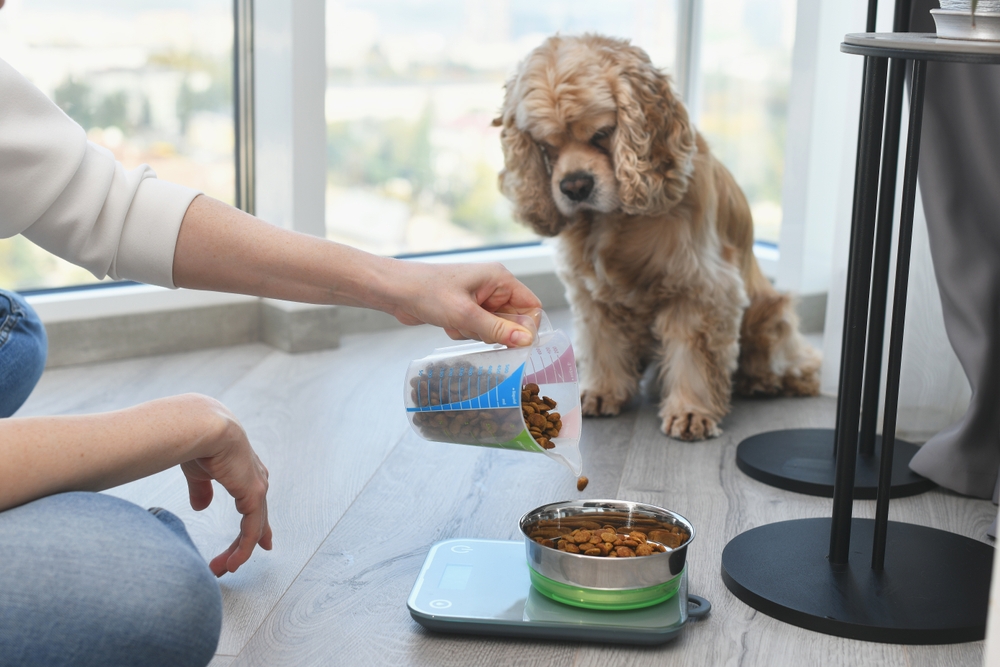
Knowing how much to feed comes down to a calculation, not the scoop. How much your pet needs depends on their ideal weight, whether they are spayed or neutered, how active they really are, medical conditions, and their life stage, and those factors can swing the daily target by a wide margin. There is a straightforward method behind it: estimate the resting calorie need from ideal weight, multiply by a factor for life and activity, then convert that into a measured portion and check it against your pet’s body over the following weeks. Two dogs of the same weight can land on very different numbers, which is exactly why the bag’s one-size guideline so often misses.
Carrying extra weight is one of the most common drivers of preventable disease in pets, which is why we treat the feeding number as a clinical detail rather than a default off the bag. At Valley Center Veterinary Clinic, our wellness and preventive care visits include a personalized nutrition conversation at every exam, and we walk you through the reasoning so you leave knowing what steps to take. If you would like a weight and nutrition review, schedule a visit and we will work through it with you.
The Math Behind the Bowl
- It is a calculation, not a guess: ideal weight, spay status, activity, and age all feed the number.
- Start from resting needs: a simple formula estimates the baseline, then a factor scales it.
- Convert carefully: calories only become a portion once you read your food’s calories per cup.
- Verify with the body: body condition over a few weeks tells you whether the number was right.
What Actually Determines How Much to Feed?
Five inputs do most of the work when determining how much to feed, and the bag accounts for almost none of them. Your pet’s ideal weight rather than current weight, their spay or neuter status, their true activity level, their life stage, and any health conditions each drive the calculation.
The biggest single lever is being altered, since spayed and neutered pets need roughly 20 to 30 percent fewer calories than intact ones. Activity is next, with a working dog and a couch companion of the same breed needing very different amounts. Age tilts it too, higher for growing puppies and kittens and usually lower for seniors. Plug the right inputs in and the calculation gets close; rely on the bag and you skip all five.
Each diet will have different calories per cup, so if you switch foods, don’t assume you can just feed the same amount. If you want a diet that gives maximum volume with minimum calories to help your pet feel like they are getting a feast while still staying on a diet, prescription weight-management diets with controlled fiber help pets feel full on fewer calories.
How Do You Calculate Your Pet’s Calorie Needs?
The method vets use has two steps, if you want to do the math:
- First comes the resting energy requirement, or RER, the calories a pet burns at rest, estimated as 70 times the ideal body weight in kilograms raised to the 0.75 power.
- That RER is multiplied by a factor that reflects life stage and activity to reach the maintenance energy requirement, the real daily target.
Online tools like the Pet Nutrition Alliance calorie calculator run this same math for you if the exponents are not your idea of fun, and they are a reliable shortcut as long as you feed in the ideal weight, not the current one. Cross-checking the result against guidance from the obesity prevention calorie calculator helps you sanity-check the number before committing to it.
These calculations are starting points, not gospel, which is why the next two steps, converting to a portion and checking the body, matter just as much as the formula.
How Do You Turn Calories Into a Daily Portion?
A calorie target is useless until it becomes a measured amount of food. Every bag lists a calorie density, usually as kilocalories per cup or per can, and dividing your pet’s daily target by that number gives the daily volume. A 600-calorie dog eating a food with 400 calories per cup gets a cup and a half, split across meals. Accuracy matters here more than people expect, since studies show families using a cup scoop over-portion by 20 to 50 percent, so a kitchen scale measuring grams is the more reliable tool. If you prefer a scoop, weigh what it actually delivers once to calibrate it, and remember to subtract treats from the total rather than adding them on top.
Cats that drop weight too fast carry a risk: rapid loss can trigger hepatic lipidosis, a serious liver disease, which is why a structured plan for feline weight loss stays slow and supervised rather than aggressive.
How Do You Check the Number Is Right?
The calculation gives a starting estimate, and your pet’s body tells you whether it was correct. The feedback loop is body condition scoring, and the body condition scoring chart lays out the nine-point scale where 4 to 5 is ideal, with ribs you can feel under a thin layer of fat, a visible waist from above, and a belly that tucks up from the side. This method works better than just weighing your pet because it also takes muscle into account, which weighs more than fat, and can seriously skew results when relying on the scale alone. Reassess every few weeks, adjust the amount of calories up or down by 5 to 10 percent based on what you find, and you converge on the right number. We score body condition at every wellness exam, and we’re happy to both share our findings with you and teach you how to do it.
What About the Treats in the Math?
Treats are part of the calculation, not an exception to it. Hidden calories add up fast, and the breakdown of calories in treats puts real numbers on common offenders. On a 20-pound dog’s roughly 600-calorie day, a medium biscuit is about 40 calories, a tablespoon of peanut butter about 95, and a dental chew 70 to 100. The rule that keeps the math honest is the 90/10 split, where treats stay under 10 percent of daily calories and the meal portion drops to make room. Lower-calorie swaps work well here:
- Green beans, fresh or frozen: roughly 4 calories per quarter cup.
- Baby carrots or carrot slices: about 4 calories each.
- A few blueberries or apple slices (no seeds or core): under 10 calories per serving.
Pets respond to the reward and the ritual, not the calorie count, so the swap rarely registers as a loss. If your pet is feeling like they aren’t getting enough, try to stretch the portion with enrichment: puzzle feeders, slow bowls, and scatter-fed kibble all make a smaller portion last longer, which is one of the best tools for healthy weight loss in dogs and cats alike.
When Does the Calculation Not Add Up?
If the math is right and the weight still will not follow, a medical cause may be overriding it. A short list of conditions is worth considering when the feeding plan looks correct on paper:
- Hypothyroidism and Cushing’s Disease in dogs drive steady weight gain even on a measured portion.
- Hyperthyroidism in cats causes loss despite a big appetite.
- Diabetes mellitus, cancer, and kidney disease all distort weight, appetite, and body condition in their own ways.
- Chronic pain or dental discomfort quietly changes how much a pet eats and moves.
Excess weight feeds its own list of problems that show up downstream:
- Urinary stones form more readily in overweight pets.
- Joint disease and intervertebral disc disease progress faster under extra load.
- Systemic hypertension rides along with excess weight.
- A thinner margin against heat stroke, a real concern in the Valley Center summer.
Diagnostics, like blood panels, x-rays, and ultrasound, may be recommended if your pet’s weight is changing without you making a change, or if the weight just isn’t coming off despite you trying. Valley Center offers a full range of in-house diagnostics to track down the potential causes.
How Often Should You Recalculate?
Because the inputs change, the calculation is not a one-time event. A pet’s needs shift with age, activity, weather, and health, so what was right at three may overfeed at eight.
Re-run the math at every checkup: routine wellness visits are the natural place, with closer attention during the life-stage transition visits. Chubby puppies are more prone to orthopedic issues. Adult dogs and cats need a calorie decrease once they’ve stopped growing. Senior pets are more prone to diseases causing weight changes. At every visit, tell us what you’re feeding and ask us if we’d recommend a change. We’re here for that conversation.
Frequently Asked Questions About Calculating Pet Food Portions
Do I Calculate From My Pet’s Current Weight or Ideal Weight?
Ideal weight, always, when the goal is weight loss or maintenance for an overweight pet. Calculating from current weight just maintains the excess. For a pet already at a healthy weight, current and ideal are the same number, so it does not matter, but for an overweight pet the difference is the whole point.
How Precise Does the Calorie Number Need to Be?
Precise enough to start, then refined by results. The formula and calculators get you a solid estimate, but no equation perfectly predicts an individual metabolism. The real accuracy comes from feeding the estimate for a few weeks, checking body condition, and adjusting. Treat the number as a hypothesis you test, not a fact you obey.
Can I Measure With Cups Instead of Weighing?
Cups work, but a scale is more accurate, since cup users over-portion by 20 to 50 percent. Weighing in grams gives the precision the calorie math deserves, especially for a pet on a weight plan. If you stick with a cup, weigh its actual output once so you know what it really holds.
Do Wet and Dry Food Change the Calculation?
The calorie target stays the same; only the conversion changes. Wet food is far less calorie-dense than dry, so the same daily calories become a much larger volume of canned food than kibble. If you feed both, add up the calories from each rather than eyeballing the portions, since a half-can plus a scoop is easy to misjudge. The label gives the calories you need for the math either way.
My Pet’s Calculated Amount Looks Too Small. Is That Normal?
Often it is. A properly calculated portion frequently looks smaller than the bag suggested or than your family expected, especially for an altered, indoor pet. As long as the food is complete and balanced and your pet’s body condition holds in the ideal range, the smaller-looking amount is doing its job. Hunger is better met with higher-satiety food and enrichment than with calories the math says are not needed.
Valley Center Veterinary Clinic Is Here to Help
The right number is not a mystery once the inputs are your pet’s, not the bag’s, and our job is to help you find it and hold it. Getting feeding right is one of the highest-leverage things you can do for your pet’s long-term health, since maintaining an ideal body condition reduces the risk of arthritis, diabetes, urinary disease, and a long list of other conditions that show up downstream of carrying extra weight. Whether your pet is a growing puppy who needs the math redone every few months, a recently spayed adult whose calorie needs just dropped meaningfully, or a senior whose metabolism and activity have shifted, a clear feeding plan that fits this pet, today, is worth more than any guideline on a bag.
If you have questions about your pet’s current portion, want help interpreting their body condition, or are working through a weight loss plan that has stalled, we are happy to sit down and work through it with you at your next visit. Request an appointment and we will work through the calculation together.





Leave A Comment